Biocompatibility Evaluation of Medical Devices Made from Biomaterials
Share to
Classification of medical biomaterials can be approached from multiple dimensions.
Based on material properties, medical biomaterials are primarily classified into the following categories:
The first category is inorganic biomaterials, including bioinert and bioactive ceramics. In physiological environments, bioinert ceramics (such as medical carbon materials) serve to establish interfaces and maintain stability, while bioactive ceramics (such as bioactive glass) promote bone tissue deposition, are degradable, and can be replaced by new tissue.
The second category comprises organic biomaterials, including natural and synthetic biomaterials. Natural biomaterials (e.g., collagen-based) offer excellent tissue compatibility. The fastest-growing segment is synthetic polymeric medical materials, which provide superior mechanical properties and adequate biocompatibility. Soft synthetic polymers are commonly used as substitutes for soft tissues such as blood vessels, the esophagus, and finger joints, while hard synthetic polymers serve in applications like heart valves and ball-and-socket valves.
The third category comprises metals and alloys, including cobalt-chromium, cobalt-chromium-nickel, titanium, stainless steel, and nickel-titanium shape memory alloys. Products manufactured from these materials include artificial joints, bone implants, and intravascular stents. Notably, nickel-titanium alloys feature intelligent shape-memory properties and are widely used in orthopedics and cardiovascular surgery.
The fourth category is composite biomaterials, which consist of two or more different materials and are used to repair or replace human tissues or organs. Based on the base material, they are classified into polymer-based, metal-based, and ceramic-based composites, such as carbon fiber-reinforced bioactive glass.
The fifth category is hybrid biomaterials, which are composites of biological and non-biological materials. This includes hybrids of synthetic and natural materials with biological components, as well as hybrids combining these materials with cells. The sixth category is bio-derived materials—non-bioactive materials whose structure and function mimic natural tissues, such as artificial heart valves.
Current key research areas in the biomaterials industry include regenerative medicine biomaterials and implantable devices, surface modification of biomaterials, and drug delivery./Development of gene controlled-release carriers and related systems. Biocompatibility evaluation methods are also evolving, incorporating various technical approaches such as in vitro cell culture, animal studies, and computer simulations. The 3-(4,5-dimethylthiazol-2-yl)-2,5-diphenyltetrazolium bromide (MTT) colorimetric assayMTT)因其操作简便、敏感性高,成为常用的细胞毒性评价方法。
Biocompatibility Evaluation of Medical Biomaterials
Biocompatibility evaluation of medical biomaterials follows two core principles: biosafety and biofunctionality.
The principle of biocompatibility aims to eliminate material-induced damage to the host, requiring that materials do not cause adverse reactions such as cytotoxicity or carcinogenicity. The principle of biofunctionality emphasizes the material's ability to elicit an appropriate host response and requires evaluation of its toxic side effects and impact on biological function.
The evaluation process mainly includes the following aspects.
First is the biosafety evaluation, which includes cytotoxicity testing, sensitization testing, irritation testing, systemic toxicity testing, genotoxicity testing, implantation testing, and more. Cytotoxicity testing determines whether a material kills cells, commonly using methods such as direct contact, agar diffusion, orMEMQualitative detection using the extraction method, andMTTfor quantitative detection. Sensitization tests assess whether materials trigger allergic reactions, typically using the Guinea Pig Maximization Test or the Local Lymph Node Assay. Irritation tests evaluate a material's potential to cause irritation to the skin, mucous membranes, or eyes.
Secondly, biocompatibility evaluation focuses on hemocompatibility properties such as antiplatelet activity, anticoagulation, and hemolysis resistance. Testing categories include the complement system, coagulation system, fibrinolysis system, platelets, hemolysis, leukocyte activation, and material surface analysis. Each category contains specific test items; for example, within the complement system:C3a、C5a、Bb、C4d、C5b-9in the coagulation systemFactor VIIIa、F(1+2)、TAT、FPA、APTTetc.
Third is biocompatibility assessment, focusing on cell adhesion, growth inhibition, and inflammatory response. Implantation studies, conducted via subcutaneous or intraosseous implantation, observe tissue responses to the material to evaluate its long-term biocompatibility. Genetic toxicity and carcinogenicity testing are commonly used.AmesExperimental and molecular testing methods to assess whether a material poses mutagenic or carcinogenic risks.
Classification and Evaluation of Biocompatible Materials for Medical Devices
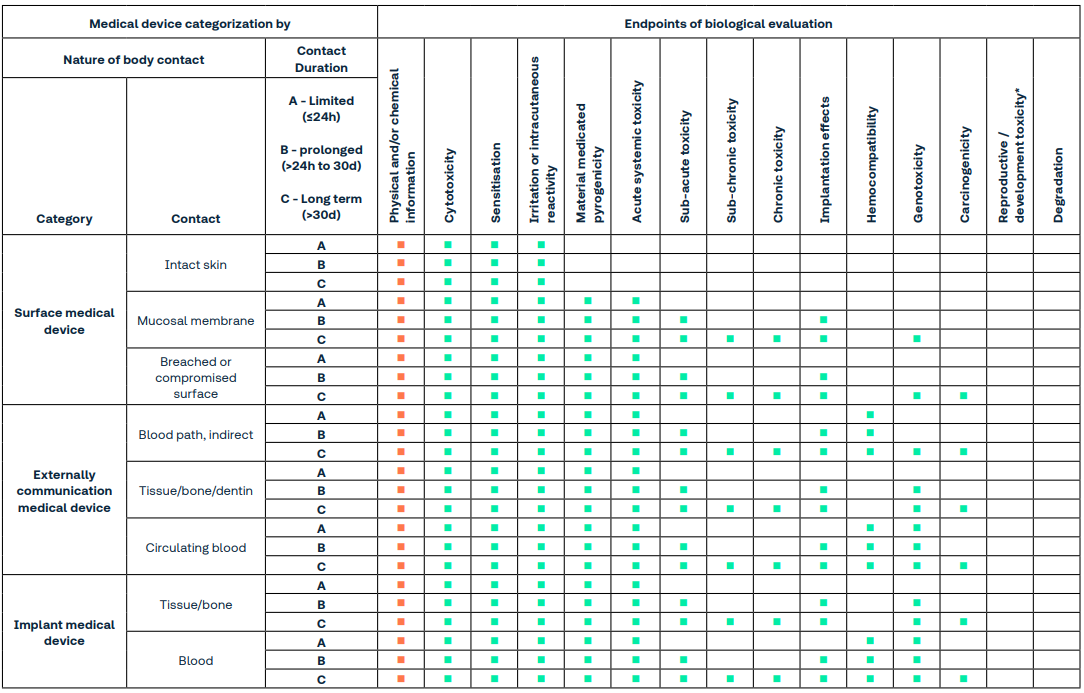
Medical devices are classified by contact nature and duration, which forms the basis for selecting biocompatibility evaluation items.
Based on the nature of contact, medical devices are classified into three categories: surface-contacting devices, external access devices, and implantable devices. Surface-contacting devices include those that come into contact with the skin, mucous membranes, or broken/Medical devices in contact with damaged surfaces, such as bandages and surgical dressings. Externally accessed devices involve implantable components and delivery systems, such as intravenous catheters and cardiac pacemakers. Implantable devices are fully embedded within soft tissue, bone, or the dental pulp system, such as artificial joints and orthopedic fixation screws.
By duration of contact, medical devices are classified as short-term contact (cumulative contact≤24hours), long-term exposure (cumulative exposure >30days), and prolonged contact. For medical devices with transient contact, biocompatibility testing is typically not required, but cumulative usage time and material residue must be considered. If a medical device falls into multiple contact duration categories, the more stringent testing and evaluation criteria should apply. Devices subject to repeated contact require assessment of cumulative effects, and repeatedly used restorative materials must be evaluated for the risk of residual substance accumulation.
Based onGB/T 16886.1-2022Standard AppendixATableA.1Different types of medical devices require different biocompatibility testing. The core three tests (in vitro cytotoxicity, skin irritation, and skin sensitization) apply to all medical devices that come into contact with the human body.
Mucosa-contacting devices require mucosal irritation or eye irritation testing; blood-contacting devices require full biocompatibility testing, including hemolysis and thrombosis; for contact duration exceeding24Hourly requirements must include acute systemic toxicity and pyrogen testing; long-term implantable devices must include genotoxicity testing, such asAmestests, chromosomal aberrations, etc.
For example, blood pressure monitors are classified as short-term surface contact devices and require only basic three-item testing. In contrast, heart valves are durable blood-contacting implantable devices that must undergo multiple high-risk tests, including cytotoxicity, sensitization, irritation, acute systemic toxicity, hemocompatibility, genotoxicity, and implantation studies.
Evaluation Criteria and Standards
Key references for biocompatibility evaluation of medical devices include international standards.ISO 10993Series and National StandardsGB/T 16886Series.ISO 10993As an internationally recognized standard, it provides a systematic framework for biocompatibility assessment of medical devices. This series covers the entire process from material screening to final product evaluation, ensuring that devices do not cause adverse reactions during clinical use.
GB/T 16886The series of standards serves as the core guideline for evaluating biocompatibility of medical devices in China, based onISO 10993Establishes a systematic framework for the biocompatibility assessment of medical devices (including various biomaterials).GB/T 16886.1-2022This is the latest core standard, effective as of2022went into effect this year, providing medical device manufacturers with more comprehensive testing guidelines. This standard was developed underISO 10993-1:2018A national recommended standard developed on this basis, primarily specifying the basic principles and requirements for biological evaluation of medical devices.
GB/T 16886Series standards include20The sections cover animal welfare, genotoxicity, blood interactions, cytotoxicity, implantation response, sterilization residues, degradation products, irritation response, systemic toxicity, sample preparation, material degradation products, ceramic degradation products, metal degradation products, toxicokinetic studies, leachable limits, material chemical characterization, physicochemical properties, and immunotoxicology testing. These sections are interconnected, forming a comprehensive biocompatibility evaluation system.
Latest StandardGB/T 16886.17-2025(Toxicological Risk Assessment of Medical Device Components) will be2026year9Month1takes effect formally; the standard specifies the process and requirements for conducting toxicological risk assessments of medical device components, as well as the methods and criteria for evaluating whether exposure to a given component poses significant harm.
Regarding test implementation, biocompatibility testing must comply with Good Laboratory Practice (GLP) and/orISO/IEC 17025Standard. ChinaGB/T 16886Series Standards andISO 10993While the series standards share largely identical content, Chinese standards retain certain distinctive requirements for test items, such as pyrogen testing and hemolysis testing.
Medical device manufacturers should, based on the nature and duration of contact, in combination withGB/T 16886.1-2022AppendixATableA.1requirements to accurately determine the required biocompatibility testing items, ensuring that sufficient safety evaluation is completed before clinical trials and market launch. Biocompatibility studies are a critical assurance of medical device safety and effectiveness, spanning the entire product lifecycle from R&D and regulatory submission to production quality control and clinical use.